

.png)

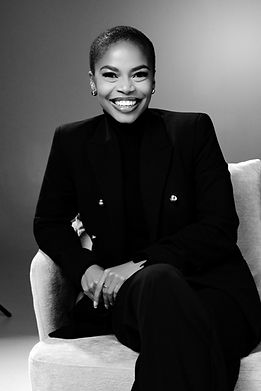
Mamodibe
Ramodibe
Biography
Mamodibe Ramodibe is a Storyteller (screen and stage actress), Television scholar and Speaker based in Johannesburg, South Africa. She holds a BA Honours in Dramatic Arts from the University of the Witwatersrand and an MA in Film and Television Studies from the University of Cape Town.
Mamodibe’s research interrogates the figure she coins as the 'transgressive' Black matriarch in South African telenovelas. The study focuses on how gender, power, and morality are mediated through storytelling. Her work is grounded in Black feminist thought and Afro-centric frameworks, with an emphasis on how media shapes cultural and political imaginaries.
As both a practitioner and scholar, her work bridges creative practice and critical inquiry, exploring the intersections of performance, narrative, and cultural representation. She has engaged public scholarship through academic conferences, namely: South African Communications Association (SACOMM) in 2024 and recently at the UNISA- UPSA GHANA Research Symposium in May 2026.
She is an Independent Scholar and a research candidate for Frames of Freedom & FAME Week Africa Program.
TRANSGRESSIVE MATRIARCHS: AN EXPLORATION OF FEMALE AGENCY AND RESISTANCE IN SOUTH AFRICAN TELENOVELAS
This study explores the concept of transgressive Black womanhood in two South African telenovelas, examining whether acts of transgression disrupt existing depictions of the matriarchal figure onscreen. Drawing on the works of Sisonke Msimang, Pumla Gqola and Sabine Binder, specifically their analyses of the iconography surrounding Winnie Madikizela-Mandela, this paper interprets the two Black female protagonists under this study within a political and historical framework. Through close textual analysis, this study examines the narrative construction and characterisation of Lindiwe Dikana from (The River 2018 - 2024) and Harriet Khoza from (The Queen 2016 - 2023) assessing the extent to which these characters transgress social and cultural boundaries. In addition, it investigates whether their transgressions perpetuate stereotypical portrayals or complicate the traditional depiction of the Black matriarch in South African television.
This study finds that, while the character constructions of both Lindiwe Dikana and Harriet Khoza are rooted in heteronormative portrayals of traditional gender roles—where both are established as wives and mothers—they transgress prescribed notions of motherhood and challenge gendered social norms of femininity. Moreover, the analysis reveals that these characters not only subvert sociocultural expectations surrounding motherhood and femininity but also defy societal norms related to widowhood, as exemplified in the case of Harriet Khoza. These transgressions emerge as modes of resistance, alternative expressions of identity, and the exercise of agency within patriarchal structures. In the analysis of The River (2018–2024), this study draws on Viraj Suparsad’s (2022) concept of 'complicated femininity' to explore the moral ambiguity of Lindiwe Dikana, a complexity seldom attributed to Black matriarchal figures in mainstream media. In contrast, the examination of The Queen (2016–2023) utilizes Sabine Binder’s notion of 'violent female masculinity' to illustrate how violent acts can be interpreted as transformative, particularly when they serve to transgress and destabilize constructed norms of femininity. This study concludes that the episodes selected from the respective telenovelas offer a nuanced and complex portrayal of Black matriarchal figures, presenting innovative and layered representations of Black women on screen.