

.png)

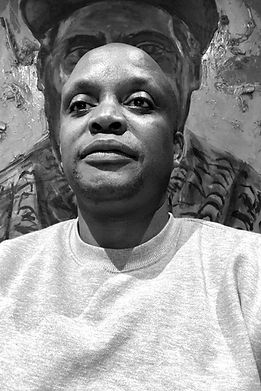
Kolodi
Senong
Biography
An artist-researcher, Kolodi Senong teaches student teachers to use the visual arts as a pedagogy in South African schools. His studio practice explores the limits of materiality and contemporary visual language, moving fluidly between figurative traditions and abstract expressionism. The work investigates localised experiences and identities as the centre of its existence. His current creative research focuses on the intersection of liberation aesthetics, phenomenology, and Afrocentricity, using tactile properties of painting to map the complications of the human psyche. Senong’s work navigates the current discourse on practice-led research within the South African higher education sector. His current submission to the Artivism Conference, titled PULSE: Afrocentric Expressions, serves as a visual inquiry into the complexities of the post-colonial subject.
Kgogo ke kgogo
Institutional Affiliation: University of the Witwatersrand
Medium: Oil on canvas
Dimensions: 90 x 100 cm (Three individual pieces)
These paintings investigate the intersection of internal psychological landscapes and contemporary African identity. Operating within the conceptual framework of Artivism, the work responds to the reclaiming and transformation of standard African narratives by offering a reimagined Afrocentric experience. By zooming in on the human psyche, the paintings initiate an ongoing, exploratory conversation about memory, self, and cultural evolution.
Methodologically, this practice is driven by obsessive experimentation with the unique materiality of oil paint. Although these creative roots began firmly in figurative painting, a persistent sense of incompleteness pushed the studio process beyond the constraints of strict figuration. To capture the intangible essence of human consciousness, the technique relies on pushing and pulling paint pigments across the two-dimensional surface. This creates dynamic tonal and textural variations that construct deep, non-traditional spaces on the canvas.
The resulting compositions utilise a singular, abstract representational mark-making language that sits deliberately within the boundaries of contemporary global painting. These works transcend mere depiction of external reality, functioning as visual sites of inquiry where feelings and cultural sensibilities converge. By manipulating the physical properties of the paint surface, the artworks challenge traditional ‘normal’ aesthetics and establish an alternative visual vocabulary for the African experience. Ultimately, this submission serves as a creative research intervention, illustrating how practice-based abstract art can actively interrogate the complexities of the modern human psyche and contribute to the ongoing struggle for liberation discourse in higher education.
Keywords: Afrocentricity, Abstract Figuration, Materiality, Consciousness, Transformation