

Where the rubber meets the road: SAMTIC’s international training in action
- 5 days ago
- 2 min read
By Nicole Govender

The South African Music Technology Innovation and Capacity-building (SAMTIC) project, launched in November 2025, shifted into high gear in April 2026. The next phase of this initiative enabled person-to-person interaction, training and mentoring at the Hochschule für Musik Nürnberg and the University of Sofia, St. Kliment Ohridski. Through a series of staff training sessions and workshops, South African academics were given the opportunity to engage directly with their institutional counterparts in Europe, thereby gaining firsthand experience with advanced music technologies, artificial intelligence and educational frameworks.

A delegation of lecturers and professors from the South African institutions involved in the project – including Tshwane University of Technology (TUT), University of Pretoria (UP), University of Witwatersrand (Wits) and UNISA – made their first visit to the partner universities in Germany and Bulgaria. These visitations are part of the SAMTIC project’s strategy to strengthen academic capacity, foster collaboration and ensure the transfer of knowledge and expertise between consortium partners.
At the Hochschule für Musik Nürnberg, the delegates engaged in a highly structured and technologically advanced learning environment. This programme provided in-depth exposure to professional recording studios, modern performance venues and integrated audio-visual systems. The delegates also participated in workshops that explored microphone techniques, signal flow, studio acoustics and hybrid analogue-digital workflows. This direct approach was an invaluable learning experience, enabling participants to refine their technical skills while gaining insight into industry-standard practices.

A key highlight of the visit was the integration of artificial intelligence into music performance and production. A live demonstration featured musicians interacting with AI-driven systems, including automated accompaniment and intelligent audio-processing tools. These experiences not only showcased the creative possibilities of AI but also encouraged critical reflection on its limitations and future role within music education.
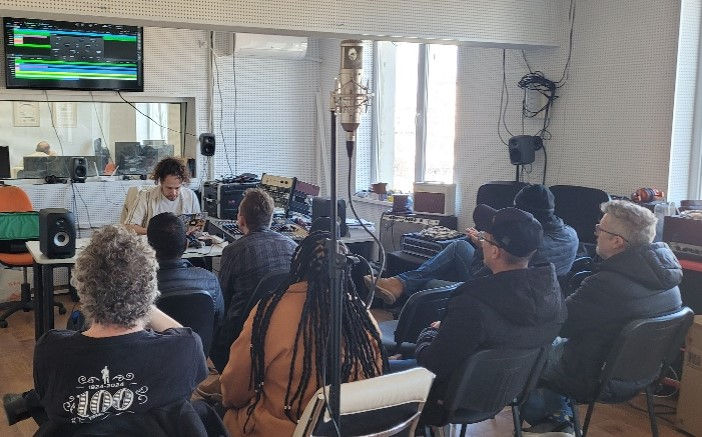
The visit to the University of Sofia in Bulgaria offered a more foundational perspective, focusing on the core recording practices and curriculum structures. The delegates were a part of live recording sessions and engaged in immersive audio technologies (such as Dolby Atmos). The experience provided valuable insight into how traditional music practices can be integrated with modern technology, further underscoring the importance of strong foundational music training.
Although the experiences differed, they were both meaningful and necessary contributions to fulfilling the purpose of the SAMTIC project. Both institutions provided a balanced understanding of fundamental and advanced approaches to music technology education.
The trip created valuable opportunities for direct engagement between South African and European partners, enabling meaningful exchanges of ideas and discussion. The delegates returned with practical insights that are already being implemented in teaching approaches, curriculum updates and the development of recording facilities at their respective institutions.
SAMTIC is not only about technological advancement, but also about building sustainable capacity, encouraging innovation and preparing both educators and students to thrive in an increasingly digital and interconnected creative landscape.


